Showing posts with label lupine publishers llc. Show all posts

Friday, January 24, 2020

Lupine Publishers| Cluster Against Climate

Lupine Publishers| Trends in Civil Engineering and its Architecture



Life on Earth depends on the circuit of water, carbon and everything that rises into the sky. In the atmosphere, their mixing, concentration, various chemical-physical processes, transformations take place, and with precipitation everything returns to the earth. On the soil, substances become the building material of bodies and plants, which, as they grow and multiply, produce waste, eat up, and waste again rise into the sky.
Humanity, in its development and the pursuit of the comfort of its existence, destroys the circuits. Vapors without changing the properties of vapors are clearly visible on the water - it came with precipitation and immediately went back to the atmosphere. In nature, such fumes come from the surfaces of water bodies, from stones, and other hard surfaces. But with the development of the industry, there are a lot of hard and impermeable surfaces, their volumes grow daily with the growth of technology and productivity. Alienated from nature territories - already more than 70% of the earth’s land. This is deep plowing agriculture, reservoirs, deforestation, asphalt and concrete pavement, garbage and ore landfills. Vapors new to nature from destroyed surfaces can be called artificial. More details can be found in: https://www. actascientific.com/ASMI/pdf/ASMI-SI-01-0009.pdf
One of the types of impermeable surfaces is garbage and ore landfills. Household garbage, in which a lot of chemical elements are concentrated, becomes the endpoint of many substances - the circuits open. At garbage landfills, rainwater moistens the upper layers of paper, plastic, metal, glass, does not find its consumers and returns to the atmosphere without fulfilling its natural functions. The main impact on nature - reducing the water cycle - is the destruction of underground infrastructure, which is located under layers of garbage. Each hectare of natural soil contains up to 20 tons of underground living creatures. All this lives, consumes water, oxygen, carbon dioxide and other gases, converts minerals and organics, releases moisture vapor, and everything else in processed form, is an important link in a single cycle of substances. It was determined that the total garbage area of the whole world occupies the same area as the entire territory of Mexico, which is growing with the development of technology (Figure 1).
All cities in the world solve the problems of recycling and recycling. The greatest success in this was achieved by the Scandinavian countries and Japan. They were able to create zero emissions, eliminated all landfills. All garbage is sorted and recycled; its own circuit of things has formed. These include metals, glass, paper, plastic, organics. All this goes to recycling and returns to reusable items. The destructive effects of these countries on natural processes are significantly reduced.
Examining garbage heaps, we find in their environment most of all plastic containers and bags that are on shelves and shop windows with liquid and bulk products, detergents, chemicals from many industries. The technology for manufacturing plastic dishes has achieved high results in terms of productivity, production volumes, and cost. Is it possible to combine or combine the action and reaction of these two categories: production and utilization. One of the main advantages of plastic products is durability - hundreds of years. But this advantage turns into a disadvantage after using the contents of the container. A variety of processes and studies are underway to reduce plastic because of this durability. Strategically protecting the environment requires reducing or eliminating the production of any kind of plastic, processing it after use, and using it in the production of other items. A variety of methods are actually being introduced to reduce the use of plastic bags and separate garbage collection.
We see a significant scatter in volumes, destinations, and packaging forms. The multitude of parameters of only utensils for filling and selling liquid products suggests the unification and standardization of all containers. Combining the efforts of designers of all types of utensils in a single standardization could reduce garbage many times and eliminate landfills. If plastic dishes do not decompose for hundreds of years, then can this factor be used for construction?
The simplest conclusion suggests itself - to make dishes in the form of a hollow brick. There are such cans with handles and corks recessed in the depths of one of the sides. In the construction of walls, these containers after use can be filled with sand, sawdust, crumpled or crushed plastic bags, crushed non-decaying waste of all other types of garbage, and lay the walls out of them. To do this, it is enough to standardize all types of dishes for a single series of sizes, choose the main size of one side of a rectangular shape, for example length, and make the others multiple in width and height. It is not necessary to do this only for plastic - this one Incip can also be used for glassware. Walls are loadbearing, but frame construction with filling annular space with lightly loaded or nonbearing walls is also known.
It is widely known that craftsmen and enthusiasts build houses from ordinary bottles. https://zen.yandex.ru/media/aleksandrov/ v-rossii-uzakonen-jiloi-dom-iz-butylok-chto-esce-mojno-sooruditiz- brosovogo-stroimateriala-5d837f573f548700ad0b38e0. A new form of utensils would allow such an army of builders to lead to the construction of their houses like these so that the replenishment of landfills would stop immediately (Figure 2). In addition, the useful area for food storage, warehousing, transportation would increase. But most importantly, the growth of landfills would cease. And coupled with the reclamation of existing ones, a significant contribution to reducing artificial and increasing organic fumes would appear - the main factor in stopping climate change.

Read More Lupine Publishers Civil and Architecture Articles :
https://lupinepublishers-civilengineering.blogspot.com/


Read More Lupine Publishers blogger Articles : https://lupinepublishers.blogspot.com

Friday, November 15, 2019

Lupine Publishers-Effect of Process Parameters on Changes in Tensile Properties of Cotton Sewing Thread

Lupine Publishers- Latest Trends in Textile and Fashion Designing

Abstract

During high speed sewing, needle thread is subjected to dynamic loading, inertia forces, friction and repeated tensile stresses at tremendous rates. The value of these stresses depends upon stitching speed, sewing thread tension, stitch length and sewing thread properties. These parameters affect the tensile properties of sewing threads adversely, leading to loss in seam strength. In this study, the effect of various parameters lubrication (%), stitch density, the number of fabric layers and stitching speed on tensile properties of sewing thread has been studied using Box- Behnken design. Contrary to the popular belief, loss in tenacity increases as stitching speed increases. 4% lubrication (%) is suggested to get minimum tenacity loss (%).
Keywords: Breaking Elongation; Initial Modulus; Sewing Thread; Tenacity

Introduction

In the apparel industry, the sewing process is one of the most critical processes in the determination of productivity and quality of the finished garment Anand [1]. The production rate of garment industry has increased significantly because of technological development. Due to increase in the machine speed, rapid modification in fabric characteristics just as fabric type, the degree of finishing has brought more stringent requirements on the characteristics and performance of threads used in garment industry Gersak and Knez [2]. It is well established that manufacturers can improve the quality of garments by using better sewing thread, improved machinery, better garment design and trained personnel. However, use of better-quality sewing thread appears to be easiest and least expensive Rengasamy [3]. Seam strength and seam performances are dependent on the strength of the threads. So, high strength of sewing thread is a basic requirement for good sewability Midha [4]. If thread becomes weaker during sewing process and after getting incorporated into the seam it results into lower seam strength.
The other tensile properties such as breaking elongation and initial modulus also influence the quality of seam in different ways. Therefore, it becomes very important to know the sewing mechanism and extent of loss in tensile properties during sewing. During the sewing process in a high-speed sewing machine, the thread is subjected to complicated kinematic and dynamic conditions. Sewing thread is subjected to friction, tensile, bending, compressive, shear, and surface stresses. These stresses act on the thread frequently for an adequately prolonged period of time; sewing thread passes more than 50-80 times through the fabric, the needle eye, and bobbin case mechanism before getting incorporated into the seam Ukponmwan [5], Midha [6]. As a result, both the sewing thread and the yarns in the fabric get abraded during the sewing process. Number of researchers observed that there could be 30-40% strength reduction in the cotton thread after sewing Sundaresan [7], Sundaresan [8]. Different studies confirm that structural damages in the thread, results due to the displacement of the plies, twist alterations at specific locations and the surface fibres get pulled out of the structure. The damages are mostly concentrated at the interlocking portion of the needle thread in the stitch, where maximum tension, bending and thread-thread abrasion takes place Sundaresan [7], Rudolf and Gersak [9]. Most of the researchers focused on estimating the amount of damage in the sewing threads during sewing and identified the various reason for that damage viz. structural damage, dynamic loading, and thermal damage. However, limited studies are available on the role of different parameters affecting the loss in thread strength after sewing. A careful selection of these parameters can help in reducing the damage in sewing threads during sewing. In this paper, the effect of process parameters like lubrication (%), stitch density, the number of fabric layers and machine speed has been studied on changes in the tensile properties (tenacity, breaking elongation, and initial modulus) of the needle threads during sewing.

Materials and Methods

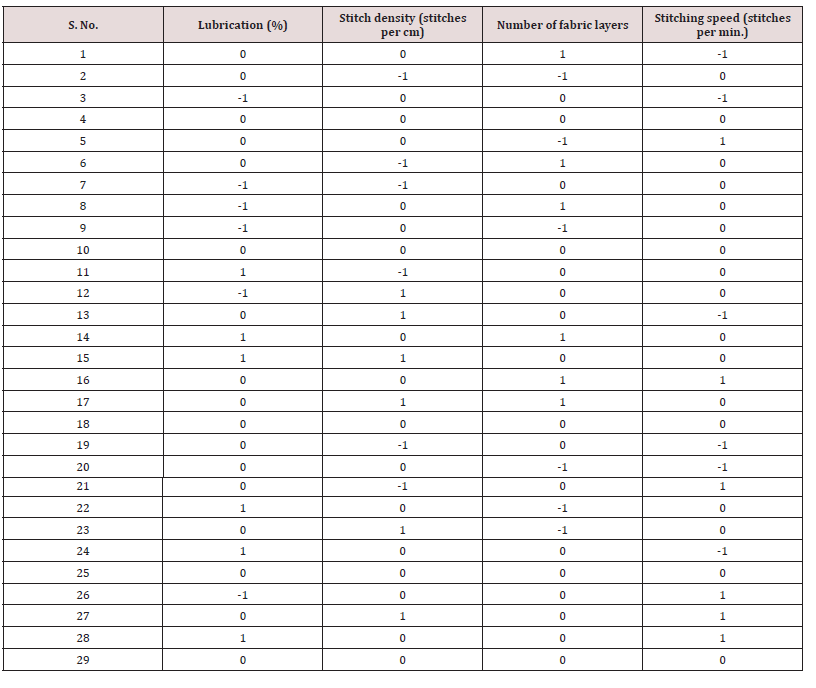
Cotton staple spun threads of 37tex with silicon and wax finish are used in the study. The threads are two and ply and shows 314 turns per meter. The physical properties of the sewing threads are shown in Table 1. The effect of various process parameters, viz. lubrication (%), number of fabric layers, stitch density and stitching speed on the tensile properties of sewing threads is studied by measuring the tensile properties of the threads before and after sewing at three different levels of these parameters, according to Box-Behnken experimental design (Tables 2-3). Brother Industrial lockstitch sewing machine is run at different speeds for preparation of samples using rib knitted fabric. Tensile testing of the needle threads before and after sewing is done at a gauge length of 250mm on Universal Testing Machine as per ASTM D 2256. Thirty tests are carried out for individual sample and the error is found to be less than 4% at 95% confidence limit. The change in tensile properties is calculated using equation 1.
Table 1: Physical Properties of Sewing Thread.
Lupinepublishers-openaccess-journals-Textile-Fashiondesigning
Table 2: Box Behnken Design.
Lupinepublishers-openaccess-journals-Textile-Fashiondesigning
Box Behnken Design.
Table 3: Box-Behnken design.
Lupinepublishers-openaccess-journals-Textile-Fashiondesigning
Loss(%)=(Tensile property before sewing-Tensile property after sewing)/(Tensile property before sewing)×100
In order to study the individual and interactive effect of each parameter on tensile properties, response surface regression equations are developed for loss in tensile properties at different levels of lubrication (%), number of fabric layers, stitch density and stitching speed by backward elimination method.

Results and Discussion

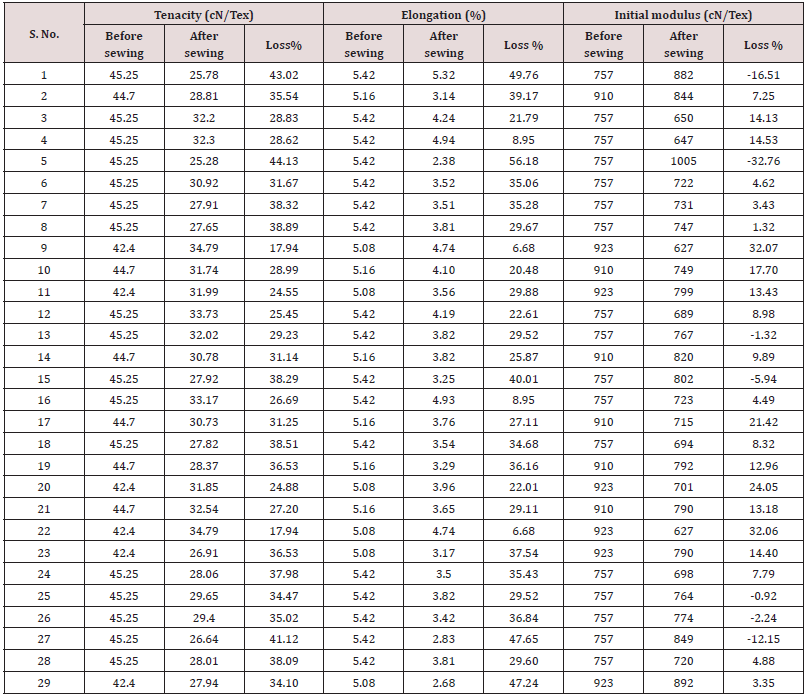
Table 4 shows the tenacity loss, breaking elongation loss and initial modulus loss after sewing at different levels of the parameters. The average of 30 readings for each sample is analyzed to create regression equation on statistical software STATISTICA 8. The linear and polynomial equations are tried along with the interaction of the parameters, at 95% confidence level. The bestfit equations for tenacity loss, breaking elongation loss and initial modulus loss are generated. The regression equations have a very good R2 value and can be used to study the effect of different parameters on tenacity loss, elongation loss and initial modulus loss.
Table 4: Sewing thread properties before and after sewing and respective loss %.
Lupinepublishers-openaccess-journals-Textile-Fashiondesigning
*-ve sign indicates gain in initial modulus.

Tenacity loss and breaking elongation loss

Analysis of variance shows lubrication %, stitch density and stitching speed has a significant effect on the tenacity loss (Table 5), whereas number of fabric layers does not show any significant effect on the tenacity loss. However, number of fabric layers and stitching speed has an interactive effect on tenacity loss. Breaking elongation is affected by number of fabric layers and machine speed. Lubrication % and stitch density does not show any significant effect on breaking elongation loss (Table 5).
Table 5: ANOVA table for Tensile Properties.
Lupinepublishers-openaccess-journals-Textile-Fashiondesigning
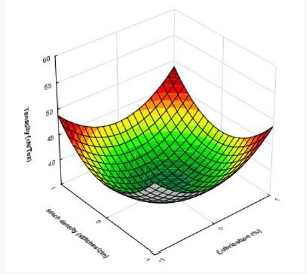
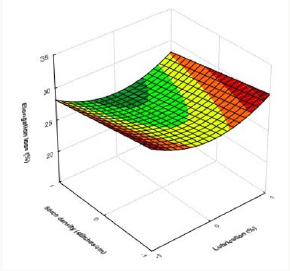
Figure 1 shows the effect of lubrication% and stitch density on tenacity loss (%) of thread during sewing. It is observed that, as the lubrication % increases, the loss in tenacity first decreases and then increases. This is because lubricants provide a surface coating to sewing threads that protect it from the abrasive actions during its interaction with machine parts, fabric and bobbin thread. But further increase in lubrication ratio causes decreases in fibre to fibre friction which leads to slippage during the tensile loading and therefore reflects as tenacity loss (%). Lubrication % does not show any significant effect on the elongation loss% as shown in Figure 2. This may be due to the increased slippage of fibres at higher lubrication, leading to increase in breaking elongation, which compensates for the loss in breaking elongation during the sewing process.
Further, it is observed that tenacity loss first decreases and then increases with increase in stitch density as shown in Figure 1. Increased level of stitch density causes a decrease in stitch length, thereby decreasing thread consumption per stitch. The stress level experienced by the thread during pulling of the thread from the spool during stitch tightening is reduced and therefore, the threads experience a lower level of damage. At higher stitch density, the thread also experiences a higher number of dynamic loading and abrasive cycles before getting incorporated into the fabric, leading to more damage to the thread. As the stitch density increased further, the effect of a higher number of loading and abrasive cycles outweighs the effect of decreased stress levels, and therefore the thread experiences higher tenacity loss Midha and Gupta [10]. Stitch density does not show any effect on the elongation loss of sewing threads as shown in Figure 2.
Figure 1: Effect of lubrication % and stitch density on tenacity loss (%) of sewing thread.
Lupinepublishers-openaccess-journals-Textile-Fashiondesigning
Figure 2: Effect of lubrication % and stitch density on elongation loss (%) of sewing thread.
Lupinepublishers-openaccess-journals-Textile-Fashiondesigning
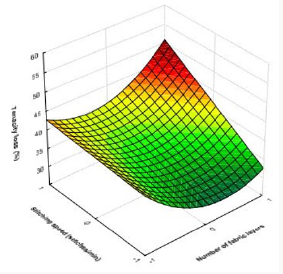
Figure 3 shows the effect of stitching speed and number of fabric layers on tenacity loss of sewing thread. It is observed that number of fabric layers does not show a notable effect on tenacity loss (%) as per analysis of variance (Table 5). However, number of fabric layers and stitching speed have an interactive effect on the tenacity loss (Figure 3).
Figure 3: Effect of number of fabric layers and stitching speed on tenacity loss (%) of sewing thread.
Lupinepublishers-openaccess-journals-Textile-Fashiondesigning

Effect of number of fabric layers and stitching speed on tenacity loss (%) of sewing thread

Figure 3 At lower stitching speed, as the number of fabric layers increase, tenacity loss decreases. But at higher machine speed as the number of fabric layers increase, a sharp increase in tenacity loss is observed. As number of fabric layers increase, the thread consumption per stitch increases. Increased thread consumption per stitch means the needle thread is subjected to a lower number of loading cycles before getting incorporated into the seam; which in turn leads to lower damage to the sewing thread. However, as the number of fabric layers increases further, the needle penetration force increases and sewing thread is subjected to higher abrasive damage. Higher abrasive damage of cotton fibers outweighs the effect of lower number of loading cycles, and therefore an increase in tenacity loss (%) is observed Midha [6].
Similarly, as stitching speed increases, at lower number of fabric layers, the marginal increase in tenacity loss is observed. But tenacity loss significantly increases, as the stitching speed increases, at higher number of fabric layers. As the stitching speed and number of fabric layers increase, higher penetration forces and higher frequency causes increase in needle temperature, which is expected to damage the synthetic threads. However, in the present study cotton thread has been used. As stitching speed increases, needle thread has more frequent interaction with various stresses imposed during sewing and therefore visco-elastic characteristics of the thread are affected. After dynamic loading of the thread at higher levels of tighening tension, the sewing thread is held retracted for stress recovery for a very short time and therefore is not able to attain stress relaxation. Due to this, stress in the sewing thread increases as the number of cycles increase. Consequently, extension of lateral molecular bonds and molecular slippage results in the breakage of these bonds.
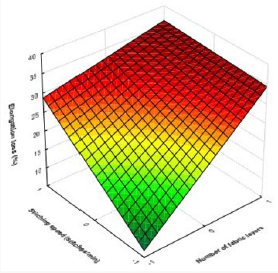
Figure 4 shows the effect of stitching speed and number of fabric layers on elongation loss (%). Number of fabric layers and stitching speed have an interactive effect on the elongation loss (Table 5). At lower stitching speed, as the number of fabric layers increase, elongation loss increases. But at higher stitching speed as the number of fabric layers increase, no significant elongation loss (%) is observed. But, when both the parameters considered separately then they have notable effect on elongation loss (Figure 4) and increasing trend is observed. As the number of layers increases, abrasion between needle thread and fabric also increases. Due to this surface of the sewing thread get damaged ultimately causing higher elongation loss (%). The same trend is observed for stitching speed. As machine speed increases, due to frequent contact of needle thread with fabric, fibres get pulled out from thread surface. So, elongation loss increases.
Figure 4: Effect of number of fabric layers and stitching speed on elongation loss (%) of sewing.
Lupinepublishers-openaccess-journals-Textile-Fashiondesigning
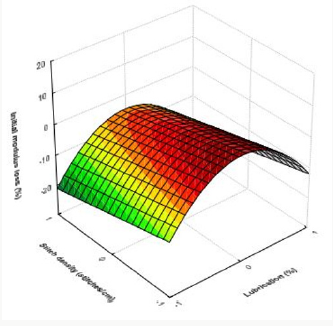
Figure 5 shows the effect of lubrication on the loss of initial modulus. As lubrication % increases from 3 to 4%, there is an increase in initial modulus loss after sewing. Because silicone oil lubricates the fiber surface and causes twist to unravel, leading to pullout of fibres from the structure of the thread. At higher lubrication %, initial modulus loss decreases. Initial modulus is known to increase after the dynamic loading of threads, whereas it decreases during the passage through the needle and fabric, and during bobbin thread interaction. The abrasive effect outweighs the increase during the dynamic loading, leading to fall in initial modulus after sewing. At higher lubrication %, the abrasive damage is expected to reduce and therefore a small increase in initial modulus due to dynamic loading, causes lower initial modulus loss. The results are similar to what has been observed by the previous researchers [6,8,10]. Further, it is observed from the analysis of variance that stitch density does not show any significant influence over initial modulus loss%.
Figure 5: Effect of lubrication % and stitch density on initial modulus loss (%) of sewing thread.
Lupinepublishers-openaccess-journals-Textile-Fashiondesigning
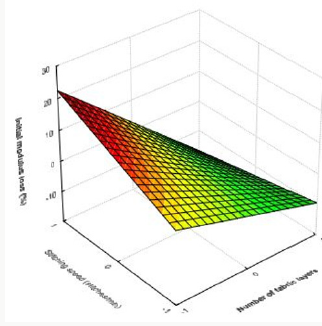
Figure 6: Effect of number of fabric layers and stitching speed on initial modulus loss (%) of sewing thread.
Lupinepublishers-openaccess-journals-Textile-Fashiondesigning
Figure 6 shows the effect of stitching speed and number of fabric layers on initial modulus loss of sewing thread. The effect of stitching speed on the initial modulus loss % is observed to have an interactive effect with the number of fabric layers (Table 5). At lower stitching speed, as number of fabric layers increase initial modulus loss slightly decreases. But at higher stitching speed, a significant drop in initial modulus loss takes place. The loss in initial modulus occurs due to the non-contribution of surface fibres to thread tension. Number of abrasive cycles cause fraying of thread surface and pull out of fibres, leading to a loss in initial modulus of threads. As the number of fabric layers increases, the number of abrasive cycles decrease, but the stress levels to which the thread is exposed during tightening is higher. With an increase in machine speed, surface of the thread gets damaged and fibres from the surface come out and that contribute to the initial modulus loss %.

Conclusion

In the present investigation, the effect of lubrication %, number of fabric layers, stitch density and stitching speed on the loss in tensile properties of cotton sewing threads after sewing has been studied. The regression equations for various responses agree well with the experimental data as indicated by higher values of coefficient of determination. It is observed that lubrication %, stitch density and stitching speed has a significant effect on the tenacity loss. Elongation loss % is affected by lubrication % and number of fabric layers. Initial modulus is affected by all the parameters except stitch density. Number of fabric layers and stitching speed have an interactive effect on loss of all tensile properties.

For more Lupine Publishers Open Access Journals Please visit our website:
To Know More About Open Access Publishers Please Click on Lupine Publishers

Follow on Twitter   :  https://twitter.com/lupine_online

Wednesday, July 3, 2019

Lupine Publishers-Journal of Textile and Fashion Designing


Kota Doria is a hand woven fabric known for its special weaving style. The light weight and airy structure improves its wearing comfort in tropical weather while the suppleness and transparency makes it graceful and fashionable. It is made up of cotton and silk yarn of varying thickness and differing combinations in warp and weft to produce a square check patterns. The silk imparts desired gloss, while cotton provides strength to the fabric.Governments has provided impetus to this industry which has resulted in almost 20 % growth in last few years. Various incentives and support schemes launched by the government in terms of technology up gradation, raw material availability, transport and logistics, marketing know how, export promotional opportunities, etc has provided platform for boosting sales of these handicrafts not only in India but also in the international market. Cotton, jute, wool and silk are the major textile substrates used to produce handicraft items like sari, shawl, dupatta, scarf, etc with characteristic weave, motifs, patterns and designs. The textile artisans are spread all across the rural areas of 29 states and 7 union territories within the country and each region has its unique style, design and art-Lupine Publishers.


For more Lupine Publishers go through the below link.

For more Journal of Textile and Fashion Designing click on below link.

Tuesday, July 2, 2019

Lupine Publishers-Journal of Textile and Fashion Designing


Denim is the term which conquers the modern world with spectacular fashion appeal. Previously the denim cloth was hardly found as fashionable wear however, it is the more common item in modern fashion trend. So, the diversification of denim fabric is the crucial demand of apparel industry. A numerous attempt especially washing treatment has been carried out in order to make denim fabrics more attractive and fashionable however, those are resulting fabric the strength and serviceability reduction. Six different decorative weaves were designed by using point carre software and 100% cotton denim fabrics were produced with same specification by using dobby loom. Visual appearance, tear strength, tensile strength, oz/yd2, shrinkage% and spirality% of decorative denim are examined and compared with the conventional denim fabric manufactured with same specification. Visual appearance of decorative denim is so attractive after performing only normal wash. The tear strength and fabric weight (oz/yd2) of decorative denim is higher than conventional denim without some exception. The tensile strength of decorative & conventional denim is more or less same. However, due to the loose structure and long float of weave, decorative denim shows higher shrinkage% and spirality%-Lupine Publishers.


Monday, July 1, 2019

Lupine Publishers- Journal of Textile and Fashion Designing


The prime purpose of this research work is to study the feasibility and the ease of knitting of cotton sheath - elastomeric core spun hosiery yarn into different fabric structures with the help of a modern multi cam track high speed circular weft knitting machine and comparing their geometric and dimensional properties. By keeping these objectives in mind, cotton sheath - elastomeric core hosiery yarn was spun. The produced spun yarn was knitted into two different fabric structures namely single jersey and popcorn jersey with identical machine parameters. Among these two fabric samples, the former one is a structure knitted with full of knit stitches and the latter one is the derivative structure of the former one and made up of the combination of knit and tucks stitches. Both these structures were subjected to their dry, wet and fully relaxed states and then their geometric properties were studied to understand the changes after each relaxation state and the potential of these structures to attain their dimensional equilibrium state was observed through repeated cycle of washing and drying. The comparison is pretty useful to understand the influence of tuck stitch into the geometric and dimensional characteristics of the popcorn fabric sample developed-Lupine Publishers.


For more Lupine Publishers go through the below link.

For more Journal of Textile and Fashion Designing click on below link.

Friday, June 28, 2019

Lupine Publishers-Journal of Textile and Fashion Designing


During recent years, a good deal of research into textile structural composites has been conducted for application in defence, space and civilian areas. Because textile structural composite materials are attractive specific properties compared to those of metals. For instance, the NASA-ACT program encouraged the researcher to initiate fibre-based advanced materials, as indicated by Dow and Dexter as well as Dexter and Hasko [1,2]. The use of textiles for technical applications has been on the rise, particularly as composites for engineering purposes. Textiles can provide performance advantages, most notably in terms of high strengthweight ratios compared to metal counterparts. This is ideal for automotive applications, where reduced weight contributes to fuel efficiency and improves ease of handling in the manufacturing process. Textile composites have been defined as “the combination of Ares in system with a textile fibre, yarn or fabric system”.The use of fibre-reinforced polymer composites (FRPC) in structural components has been being attractive to many industry sectors for decades due to their high strength-to-weight and stiffness-to weight ratio as well as high resistance to environmental degradation, which potentially lead to both energy and economic benefits over metal parts [5]. In addition, mechanical properties of FRPC can be optimized for a specific application by tailoring material content as well as orientation of reinforcing fibres in the composite. These advantages, however, can only be provided with very large manufacturing cost premiums at the present. This has been restricted the use of FRPC primarily in relatively low-volume and niche applications such as aerospace or luxury vehicles. In order to support the widespread adoption of these advanced materials, technology advancements are demanded that enable cost-effective manufacture of FRPC for high-volume applications-Lupine Publishers.
For more Lupine Publishers go through the below link.
For more Journal of Textile and Fashion Designing click on below link.

Tuesday, June 25, 2019

Lupine Publishers-Journal of Textile and Fashion Designing


The proposed model of predictions of volume wicking and wetting in 3D terry woven fabrics is based on the simplified description of the thread of terry structure, and it works with the woven fabrics description of loops thread structure. The following terry woven fabrics parameters are used in the model: woven structures, fineness of fibers, and number of fibers at the cross-section in the warps (loop, ground) and the filling. The formation of loops levels and the liquid in the longitudinal textile is described in detail, and particular phenomena are discussed. Important parameters are used in the model of wicking, limit and their performance, and facilitate evaluation of a three-dimensional plain pile warp woven fabrics. Simulation results provide information of liquid volume wicking and wetting into terry woven fabrics assemblies as a function of time. The work focuses mainly on the relationship between fiber orientation and the liquid wicking and wetting rate, the results are potential volume porosity theory in agreement with known experimental evidence. The parameters with very small influence in usual threads are disregarded. The proposed wicking and wetting model allows a functional dependence of suction height on the parameters of the fiber bundle to be expressed in analytical form-Lupine Publishers.


For more Lupine Publishers go through the below link.

For more Journals of Textile and Fashion Designing click on below link.

Monday, June 24, 2019

Lupine Publishers-Journal of Textile and Fashion Designing


Cosmeto textiles, has promising, fast emerging market for both the cosmetics industry and the textile industry. There are different types of Cosmetotextiles which are classified on the basis of end use, ingredients used and fabric used. A wide range of agents used in Cosmetotextiles are aromas and perfumes, slimming agents, moisturising agents, anticellulite agents, sunlight absorption agents and antioxidants agents. Cosmetotextiles are fashioned by grafting, microencapsulation, coating technique, doping and by incorporating different substances for health or body care that are steadily transferred to the skin by movement, pressure or the effect of the skin’s natural warmness. There are various synthetic and natural materials which are used in Cosmetotextiles such as fruit extract, like essential oils, plant extracts, flower extracts, and animal extracts as natural sources along with some synthetic substances including zinc oxide, iron oxide, ethane diol and zinc nano particles and many others. The pioneering development of Cosmetotextiles can be as wide as thoughts & imagination. It is projected that the development of Cosmetotextiles will continue to grow and discover completely new possibilities for providing various body care functions to the wearer in the near future-Lupine Publishers.


For more Lupine Publishers go through the below link.
For more Journal of Textile and Fashion Designing click on below link.

Friday, June 21, 2019

Lupine Publishers-Journal of Textile and Fashion Designing


Dirty Linen? by Ashok Athalye in LTTFD- Lupine Publishers.

Linen used to be the most widely used textile material for apparel clothing for ages during the primordial era. Additionally, owing to its strength, durability and long lasting property, the ancient Egyptians were considered to use it even as a currency. Thus, Linen was an intrinsic and intimate component of human life and it was valued so much that cleaning of household cloths in public place probably led to the popular colloquial term of washing dirty Linen (personal matters that could be embarrassing if made public). Linen which ruled the northern hemisphere garb for thousands of years lost its importance in the last few centuries as another natural fiber “Cotton” also initially marketed as white gold gained prominence during British colonization in Asia and the advent of industrialization. Availability of vast land mass for cultivation of cotton in Indian subcontinent, claimant tropical weather conditions, cheap labor, ease of downstream processing, etc boosted popularity of cotton and it became the most popular textile substrate around the globe within a short time. Linen, which enjoyed a lion’s share among the natural farm-cultivated textile substrates until the 17th century, lost its mare and reduced to hardly 1 % of total textile fiber consumption by mid 19th century. However, last few decades have witnessed revival of Linen and usage of this long and thick fiber in apparel and home furnishing segment- Lupine Publishers.


For more Lupine Publishers go through the below link.

For more Journal of Textile and Fashion Designing click on below link.

Thursday, June 20, 2019

Lupine Publishers-Journal of Textile and Fashion Designing


Jewellery is a mesmerizing term which any feminine gender would love to admire and afford. Instantly, this magic term recalls about ornaments made up of gold, silver, platinum etc., in our minds. But the 21st century scenario is very different where the word jewellery has a different connotation. In the recent years, may be women would have felt jaded of using the above mentioned ornaments which led to a change in artificial jewellery. Popularly termed as funky, imitation, bling, modern or fashion etc., are the new terms and the current trends go on. Though, such discernments are stated to revelation on the social status, invariably such artificial jewellery is worn right from the poor to the rich. No doubt that so called artificial jewellery has made a mini industrial revolution among the metropolitan women who are supposed to admire such antiques wearables from head-to-toe [1,2]- Lupine Publishers. 


For more Lupine Publishers go through the below link.

For more Journal of Textile and Fashion Designing click on below link.

Wednesday, June 19, 2019

Lupine publishers-Journal of Textile and Fashion Designing


Some 880 trends died this century, I was reading somewhere. There is fatalism behind these numbers. Isn't it a way of life lost? The danger is to the small industries that get set up to sustain that trend. Why isn't this seed taken forward? When we do trend analysis, then what do we calculate. We search the reasons of its evolution and its growth and then fading out. But do we also take in consideration of the loss of culture, myth and storytelling when a trend dies. As a storyteller I have often wondered, would we have had the story of Ras leela of Lord Krishna, if the trend of community bathing was not there in ancient Indian culture. Because when that trend disappeared, well so did the stories of Ras leela (Figure 1). And we have to be aware of the fact that trends of fashion and print evolve from the community or social trends as we call it. For example during the Jazz Age, Cloche hat became increasingly popular because women loved the look of cloche hat paired with their Eton cropped hair-Lupine publishers.
For more Lupine Publishers go through the below link.
https://www.lupinepublishers.us/

Lupine Publishers| Cluster Against Climate

Lupine Publishers| Trends in Civil Engineering and its Architecture Life on Earth depends on the circuit of water, carbon and every...