Lupine Publishers| Trends in Civil Engineering and its Architecture
Read More Lupine Publishers Civil and Architecture Articles :
Read More Lupine Publishers blogger Articles : https://lupinepublishers.blogspot.com
Life
on Earth depends on the circuit of water, carbon and everything that
rises into the sky. In the atmosphere, their mixing, concentration,
various chemical-physical processes, transformations take place, and
with precipitation everything returns to the earth. On the soil,
substances become the building material of bodies and plants, which, as
they grow and multiply, produce waste, eat up, and waste again rise into
the sky.
Humanity,
in its development and the pursuit of the comfort of its existence,
destroys the circuits. Vapors without changing the properties of vapors
are clearly visible on the water - it came with precipitation and
immediately went back to the atmosphere. In nature, such fumes come from
the surfaces of water bodies, from stones, and other hard surfaces. But
with the development of the industry, there are a lot of hard and
impermeable surfaces, their volumes grow daily with the growth of
technology and productivity. Alienated from nature territories - already
more than 70% of the earth’s land. This is deep plowing agriculture,
reservoirs, deforestation, asphalt and concrete pavement, garbage and
ore landfills. Vapors new to nature from destroyed surfaces can be
called artificial. More details can be found in: https://www. actascientific.com/ASMI/pdf/ASMI-SI-01-0009.pdf
One
of the types of impermeable surfaces is garbage and ore landfills.
Household garbage, in which a lot of chemical elements are concentrated,
becomes the endpoint of many substances - the circuits open. At garbage
landfills, rainwater moistens the upper layers of paper, plastic,
metal, glass, does not find its consumers and returns to the atmosphere
without fulfilling its natural functions. The main impact on nature -
reducing the water cycle - is the destruction of underground
infrastructure, which is located under layers of garbage. Each hectare
of natural soil contains up to 20 tons of underground living creatures.
All this lives, consumes water, oxygen, carbon dioxide and other gases,
converts minerals and organics, releases moisture vapor, and everything
else in processed form, is an important link in a single cycle of
substances. It was determined that the total garbage area of the whole
world occupies the same area as the entire territory of Mexico, which is
growing with the development of technology (Figure 1).
All
cities in the world solve the problems of recycling and recycling. The
greatest success in this was achieved by the Scandinavian countries and
Japan. They were able to create zero emissions, eliminated all
landfills. All garbage is sorted and recycled; its own circuit of things
has formed. These include metals, glass, paper, plastic, organics. All
this goes to recycling and returns to reusable items. The destructive
effects of these countries on natural processes are significantly
reduced.
Examining
garbage heaps, we find in their environment most of all plastic
containers and bags that are on shelves and shop windows with liquid and
bulk products, detergents, chemicals from many industries. The
technology for manufacturing plastic dishes has achieved high results in
terms of productivity, production volumes, and cost. Is it possible to
combine or combine the action and reaction of these two categories:
production and utilization. One of the main advantages of plastic
products is durability - hundreds of years. But this advantage turns
into a disadvantage after using the contents of the container. A variety
of processes and studies are underway to reduce plastic because of this
durability. Strategically protecting the environment requires reducing
or eliminating the production of any kind of plastic, processing it
after use, and using it in the production of other items. A variety of
methods are actually being introduced to reduce the use of plastic bags
and separate garbage collection.
We
see a significant scatter in volumes, destinations, and packaging
forms. The multitude of parameters of only utensils for filling and
selling liquid products suggests the unification and standardization of
all containers. Combining the efforts of designers of all types of
utensils in a single standardization could reduce garbage many times and
eliminate landfills. If plastic dishes do not decompose for hundreds of
years, then can this factor be used for construction?
The
simplest conclusion suggests itself - to make dishes in the form of a
hollow brick. There are such cans with handles and corks recessed in the
depths of one of the sides. In the construction of walls, these
containers after use can be filled with sand, sawdust, crumpled or
crushed plastic bags, crushed non-decaying waste of all other types of
garbage, and lay the walls out of them. To do this, it is enough to
standardize all types of dishes for a single series of sizes, choose the
main size of one side of a rectangular shape, for example length, and
make the others multiple in width and height. It is not necessary to do
this only for plastic - this one Incip can also be used for glassware.
Walls are loadbearing, but frame construction with filling annular space
with lightly loaded or nonbearing walls is also known.
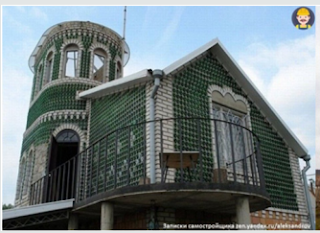
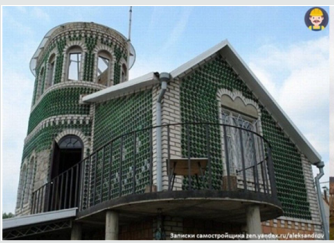
It is widely known that craftsmen and enthusiasts build houses from ordinary bottles. https://zen.yandex.ru/media/aleksandrov/
v-rossii-uzakonen-jiloi-dom-iz-butylok-chto-esce-mojno-sooruditiz-
brosovogo-stroimateriala-5d837f573f548700ad0b38e0. A new form of
utensils would allow such an army of builders to lead to the
construction of their houses like these so that the replenishment of
landfills would stop immediately (Figure 2). In addition, the useful
area for food storage, warehousing, transportation would increase. But
most importantly, the growth of landfills would cease. And coupled with
the reclamation of existing ones, a significant contribution to reducing
artificial and increasing organic fumes would appear - the main factor
in stopping climate change.
| https://lupinepublishers-civilengineering.blogspot.com/ |
Read More Lupine Publishers blogger Articles : https://lupinepublishers.blogspot.com


